
The River Ear Project: Conversation with Artist Asad Raza
This is a conversation between curator Kristine Roome and artist Asad Raza about his exhibition practice and ongoing projects. Raza creates “metabolic” art exhibitions featuring living, changing elements. In Buenos Aires, he planted red lentils and native shade-tolerant plants in century-old soil discovered between the floors of a 1903 building, creating a seven-month installation that spans all four seasons. The lentils are nitrogen fixers that improve soil quality, and also represent a personal connection as the first dish his mother taught him to cook. His recurring work “Root Sequence, Mother Tongue” features 26 trees selected to survive the predicted climate conditions 50 years in the future, displayed with human caretakers who interact with visitors and personal objects. The trees are permanently planted after each exhibition, creating lasting groves in cities like Shanghai, New York, and Frankfurt. Raza explains that trees process information one million times slower than humans through their roots and sap, creating a different temporal experience for viewers. He’s currently developing the River Ear Project in Cambridgeshire, England, a wooden, ear-shaped pavilion designed to acoustically amplify the sound of the River Granta while working to restore biodiversity to the chalk stream. The project aims to bring together the scientific community of a nearby biotech park with the local village and natural environment.
Transcript:
Kristine Roome: Hi everyone, this is Kristine Rome. I am a curator and host of the Ecological Design Collective Eco Arts Forum. Welcome back. We are here again with artist Asad Raza. It’s part of our ongoing conversation series. We’ve been following events leading up to an exhibition and art installation that he is doing on the River Granta in Cambridgeshire, commissioned by the Contemporary Art Consultancy in the UK. Welcome, Asad. It’s very nice to see you again.
Asad Raza: Nice to see you too, Kristine. And thank you.
Kristine Roome: So, we’ve been talking for over a year now. We first met you back in Barcelona in early fall 2024, when you had an exhibition at the Manifesta Biennale. Since that time, we’ve been following your work. We’ve talked about some of your prior pieces, and some of the works you’ve done over the past year.
I’ll just show a few images: Pina Magazine, the Frieze Art Fair, the High Line. There are a few we haven’t yet talked about, which hopefully we can get to in our upcoming conversations. All of this has been with an eye toward the River Ear Project, which is ongoing. Each meeting we get a little update about the project, but sometimes we also have a theme, or invite guest speakers. For this conversation, I would love for you to meet some of the students at Johns Hopkins University in the Exhibiting Cultures course.
In this course we’ve been talking about how we learn about other people and places through art and art exhibitions. We’ve also talked about how the context and the way art is displayed gives it meaning. Many museums are still regionally organized. Sometimes they invite a contemporary artist or include contemporary art, but it is still placed within geographical boundaries. Throughout the class, we’ve talked about existing artworks and exhibitions. We’ve gone to see museums. We’ve talked to curators. And I’m really excited to talk to you as an artist—someone who makes art and curates exhibitions, and who in many ways has expanded the notion of what an exhibition is.
So we’re delighted to have you. Thank you so much for joining us. What we’ll do is go over a few questions. We have about an hour, maybe a little bit less, and we’ll talk about you, your work, and some of your influences, and about your process of exhibition making. So to begin with, what I was thinking, because this course is about exhibiting cultures, maybe you could tell us a little bit about yourself. Maybe what you think of this idea of culture, and how you would identify personally, culturally. Just give us a little bit about your background.
Asad Raza: Hmm. Let me think about that. Well, one thing that’s relevant in this particular case is that I was an undergraduate and received my bachelor’s degree from Johns Hopkins University. So it’s nice to be back—virtually back. Someday, Kristine, we need to do one of these in person there so that I can feel like I came back to my roots or whatever.
Kristine Roome: You’re always welcome.
Asad Raza: You just have to stop moving long enough.
Kristine Roome: Yeah.
Asad Raza: I can keep moving and move through Baltimore. But, yeah, I studied literature there, and I was interested in literature and filmmaking when I was younger. Then I went through a period of thinking I would become a literature professor. I had some great professors at Hopkins—in the English department and the Humanities Center, which is part of now in its new guise as the Department of Comparative Thought, and also Philosophy and other departments. They didn’t have filmmaking, but I was also doing that at NYU over the summer—NYU Film School. And then, somehow, slowly, I gravitated toward creative practice rather than critical practice over time. Eventually I found myself working on installations and video in the art context. From there, I started to really work more on what I think of as live art or metabolic art or experiential art—art that is kind of dynamic and changing.
First, I was producing the works of an artist, Tino Seghal, who makes work with people and interaction, which was fascinating and enriching to do. Then slowly I started developing some of my own ideas, and for the last ten years I’ve been doing that—making exhibitions and works that have a certain relationship to performativity and liveness, or unfoldingness. But we can get into that more. Is that enough for the opening?
Kristine Roome: Part of the question, though, is how you self-identify culturally, right? I know a little about you, but we rarely talk about you personally—where you’re from, where your parents are from, that kind of thing.
Asad Raza: I can hear you wanting something specific. My parents were both born in India, and they both immigrated to Pakistan. My father, when he was about a year old—because Pakistan was formed on August 14, 1947. India and Pakistan both became independent of the British Empire on that date, at midnight from the 14th to the 15th of August 1947. My father was on a train as an infant, a one-year-old, on the 14th, crossing from where he was from—Lucknow in northern India—to Pakistan. My mother’s family immigrated to Pakistan about seven or eight years later, when it became clear to them that there was a better opportunity or possibility for life in Pakistan for them as Muslims. The two of them met in Lahore at King Edward Medical College. They came to Buffalo, New York in 1971, and they settled in the US. My mother was a gynecologist/obstetrician, and my father is a heart surgeon. I was, I was their child. So I don’t know what that means, but that would be how I explain my cultural and sort of national background.
Kristine Roome: I just find that the combination is interesting. It’s never a straight line, right? I mean, there’s a connection between Pakistan, being raised in Buffalo. You’re now based in Berlin. Um, you’ve lived here in Baltimore, I know you’ve spent some time in London. So I’m kind of curious how that all manifests itself in your work — if at all, right? The Pakistani background, the growing up in Buffalo, all these places that you’ve lived. Is it part of your work in any way? And if so, how? Or maybe not.
Asad Raza: That’s a good question. And I don’t know, but I know that there are many things which come from memories and experiences I have consciously. And then of course, on another level, everything comes from experiences I’ve had unconsciously. I think that when you make—it’s a bit of a weird thing to do—to make artworks or experiences that purport to be artistic in some way. You’re essentially saying to people that you believe you’ve done something that might be relevant to them in some way, and you would like them to come to a particular place to experience it. What do you deem relevant? What do you deem interesting or important or meaningful? And all of that comes from your own experiences. And so I’m sure that my background has formed a lot of things very fundamentally in terms of what I’m interested in, what I’m not interested in, and what I think could somehow lead one forward or unlock something for a person. I know that I wasn’t exposed to art—I was not exposed to contemporary art—so much when I was a child. But slowly I got inklings of it. And I was always interested in its proposal that there’s more than just one way to construct meaning in this world. And yeah, I guess my friend Dan Graham used to say that art is like an addiction. Once you get into it, you become kind of addicted to it, and then it changes you. And so maybe at some point I slowly got into this thing, I got a little bit addicted to this way of trying to create meaning in the world, which is obviously not linear. It’s not fully logical, and yet it can be quite important to people.
Kristine Roome: Well, I mean, speaking of just being in the world—I know you’ve coordinated, you’ve curated, you’ve been doing your own work for the past decade. You’ve worked in a lot of places across the globe. Sometimes, when I check in with you, you’re everywhere. You’re in Buenos Aires, you’re in the UK, you’re in Spain, you just always seem like you’re on the move. And I’m sort of curious—maybe this is an opportunity to bring in some of the more recent works, or for you to talk about some of your past works—but when you make an exhibition, how much of the place—the cultural regional space, the country, the culture—how much do you consider that when you make an exhibition?
Asad Raza: I don’t know. Again, I don’t think I have too many systematic procedures for these things. But certainly whenever I make a show or am invited to make a work, I do think quite a lot about the place where that’s going to happen and what it means for me to do something there. In some cases, I propose an existing work. In some cases, curators come asking for an existing work. And in some cases, I propose a new work, or curators want me to make a new work. And then we go into a different kind of territory. I do think quite a bit about the place, but not necessarily in a very systematic way. It’s not as if I compile charts of information about the place the way some institutional-critique artists tend to do. My research isn’t as systematic, for instance, as someone like Cameron Rowland, who really looks deeply into the history of a city or a country in which they’re making a new work. I do try to learn what I can, but usually at some point an idea for an experience that could be had, or a situation that could be realized, comes to me. Although in the case of the show that we’re looking at in the slide right now, it was actually very much inspired by the place, which I guess I could try to explain.
Kristine Roome: Talk us through—this is in Buenos Aires. Can you say a little bit about this work?
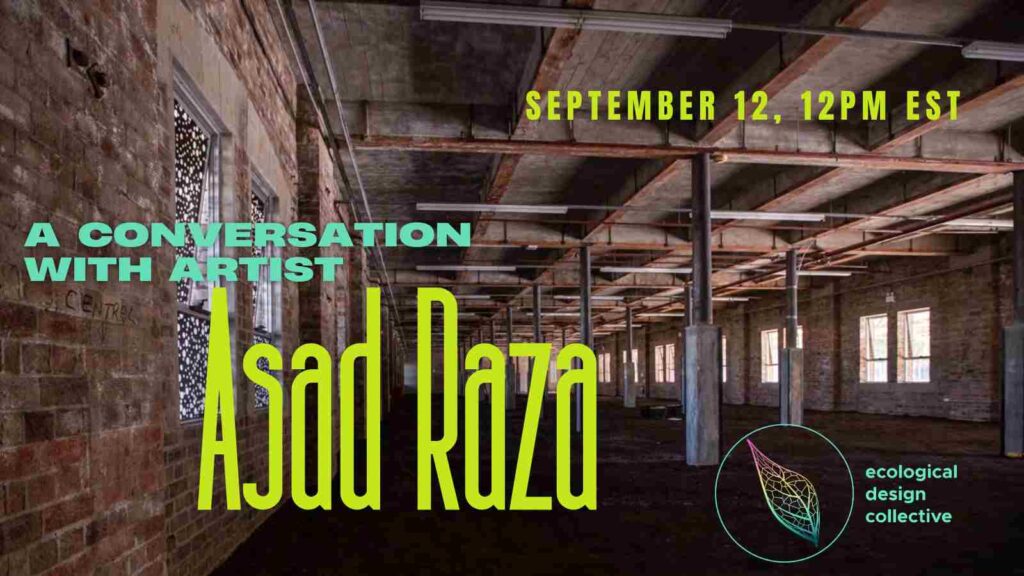
Asad Raza: Yeah. As you see, it’s an art space in Buenos Aires. And there you see the space, which is quite a long open space with these girders in it. It’s in a building called Thompson, from I think around 1903.
At some point, when they invited me to create a show there, I was looking into the building. In fact, what happened is the guy who started this place—his name is Martine Tusan—emailed me saying they’d like to do a show. I said, okay, interesting, tell me about this place.
He said, well, we’re on the fourth floor of a building, and there is something I thought you might find interesting about it… he said, well, when buildings of the early 20th century in Buenos Aires were constructed, they were insulated with soil—with earth—between the floor and the ceiling. And sure enough, I was like, oh wow. That’s quite incredible. Because, as I mentioned earlier, I’m often thinking about how to create exhibitions that are in some way alive or dynamic or active or undergoing some kind of metabolic process. And so I just immediately wrote back to him—because we were messaging—I wrote, “Wow, we could uncover the soil and plant lentils in there.” And he said, oh, well, let’s do that. And then we… you know, we actually—it didn’t exactly work out like that. But I then noticed, when he was showing me photos of the space, that there were these two long strips where the floor looked like it had been patched. And I said, what’s that? And he said, well, these strips were places where the floor was cut open and telecommunications cables were laid in the sixties or seventies, I think. I said, well, why don’t we just recut the floor in those channels, uncover the soil there, and then plant into that soil? So, both introduce ingredients into the soil that would help make it fertile again, and also plant seeds.
And in the end, I came to the idea of doing mostly native shade-tolerant plants, because there’s not that much natural light in there. There are just a few skylights. And secondly, red lentils—for two reasons. One, because red lentils (or all lentils) are nitrogen fixers, which help to infuse nitrogen into the soil and improve the soil quality.
Secondly, because red lentils were my way of making the show a little more personal, because that was the first dish that I learned to cook from my mother, who taught me to cook. So there was an element that really came from my own personal life, and then another element that came from the place—native shade-tolerant plants from Argentina and the region around Buenos Aires.
When the show opened—you’re seeing photographs of it soon after it opened—these plants had sprouted, and very small seedlings were coming up. So, in a way, I was quite happy with that because you could see something was happening, but it was in no way a spectacle. It was a very small gesture in some ways. These seedlings were small and vulnerable at the time when the show began.
Now, the show is going to run for seven months, and it started in winter in Buenos Aires in August, and it’s going to go through spring, summer, and then end in the fall. So I thought it was interesting if the show could touch all the four seasons. But I don’t know exactly how much they’ll grow during that period. I don’t think anyone does, because it’s not as if people have done a ton of plantings like this in general. But I’m happy that the plants are surviving and we were able to get the soil to perform well enough for that.
Kristine Roome: So you have this in an industrial building on the fourth floor in Buenos Aires, and there’s existing dirt that’s been there probably for who knows how many decades, and you’ve replanted and brought it back to life again and planted these lentils. What happens to the lentils when they’re grown? Will you make—will it be like a closing dinner party?
Asad Raza: That sounds fun, actually. That’s a great idea. I hadn’t thought about it because I’m not a hundred percent sure that the length of time is enough for that to happen, where we would actually get lentils. But that would be a nice way to finish the show for sure.
Kristine Roome: This is—I recognize this work, but it’s in an entirely different context. I’m wondering if you could speak to this a little bit. This must be a recent—For those who’ve read his biography, which you have— you know, as it was in the Whitney Biennial, is it 2017? And you had this work there. And now I’m seeing—I’m seeing it. Where is this one happening now? Which—can you tell a little bit? Can you—See the work—oh, sorry. This, this image?
Asad Raza: Yeah, that’s the same work that I did for the Whitney Biennial in 2017. And this is in a very, very different context, in a house museum in Frankfurt, and the same piece, which is called Root Sequence, Mother Tongue, is now spread across the ground floor of this house museum. So it’s quite a different context for me. But that is also kind of interesting because you, you see works in a different way each time you do them in a different context. And I’ve shown this work in a few museum contexts like the Rockbund Museum in Shanghai, the Whitney Biennial, and a couple other ones.
Kristine Roome: Can you say a little bit about it? Just a little brief description, in your own words, of what it is and what it is you’re doing here?
Asad Raza: There are 26 trees. And the idea is that the trees will be permanently planted afterwards. But while they’re in the museum, there are human caretakers, as well as objects that belong to the caretakers, displayed with the trees. And the other thing about the piece is, there’s always this red carpet. And the trees are selected in order to be able to survive 50 years— you know, that would be able to survive in the predicted climate of that particular area 50 years from now. So that ideally, they’ll be planted permanently and produce a grove of trees that can actually survive. And the human caretakers are present at all times of the show. They speak with the visitors, they show them the different trees, they show them the objects, and the whole thing becomes a kind of interaction, almost like a tour. And I was thinking about this piece when I was setting it up in Frankfurt and working with the caretakers there a few weeks back— that the piece also, in a way, is a kind of… meta. You know, it’s thinking about what it is to put on an exhibition. Because when you see this piece, someone comes to meet you and they start showing you these trees and objects— but the objects aren’t artworks in any traditional sense. They’re objects that belong to that group of caretakers. The trees are not artworks in a traditional sense because—they’re trees. And so you’re in a thing that has the structure of an artwork or an exhibition of art, but it seems to be working with a different kind of material. And that’s something I noticed about it when we did it this time— or it struck me that I hadn’t thought so much about before. But yeah, I think that’s a little capsule summary of that work.
Kristine Roome: What do you hope your visitors will take away from this?
Asad Raza: Uh, I don’t know. But I think museums and exhibitions are kind of like a lens, or a microscope, where whatever you put under that lens, people really examine and pay attention to. And so—there’s one subject in art that’s quite longstanding, which is this relationship of the Madonna and child, you know, like the Pietà, which is about the love between different living beings and how living beings take care of each other. And this is in a way my version of that. Because when you get in the room, it’s hard to explain it here, but when you’re in the room with this piece, and this person is taking you around and showing you these trees. You get a sense for this, this, this relationship between this person and these trees. And you also, it creates a bit of a, again, a vulnerable, um, there’s maybe a vulnerable feeling in the room because the trees tend to be quite young. They’re usually like three, four-year-old trees, and that, you know, have yet to be root bound. They’re ready to go, to be planted outside, but they’re here right now. Like they’re, they’re in a way, almost like adolescent or, or like college students or something. And this human person is trying to help them get to that point. But at the same time, the trees, the presence of living trees is very, it’s very impactful. It soothes. It gives you a feeling of, of, I think it gives you a bit of a feeling of wellbeing. And it also just gives you a sense of these living things that are very, very, very different to us operating on a very different temporality. Um, something interesting I read about trees is that if you compare trees process information, they process it quite slowly, but they process information by their roots reacting to the presence of different compounds in the soil, or for instance, different compounds that are conveyed to them by the mycelium network that connects different trees in a forest often. And then they send messages via the sap. So like the sap running to the top of the tree will be able to take those compounds, which are almost like chemical messages. And that’s how, for instance, a tree knows that, um, for instance, a tree knows which trees around it are its offspring, and it will send them more sap through the mycelium network if they need it. Because trees do this kind of sharing of resources. And in any case, the speed with which they process information, the speed of this sap is about 1 million times slower than, than what we do, than how we process information. So if you think about it like that, they’re living beings that experience time much more slowly than us. And yet they’re very, something that you can really connect to. They’re something that really feels present with, with them. And I just feel like that’s an interesting thing for people to kind of have that happen. Because what we’re, what I feel I’m used to is to go somewhere and someone has a film about, I don’t know, the rainforest being chopped down, or ancient trees in northern California or whatever. But essentially you’re watching a film, whereas in this piece, for me, what the visitors experience is they actually experience the presence of real trees, but in the place where they were probably expecting a representation, you know, a video, or, or painting, or sculptural, or photographic representation. And so that presence is underlined by the fact that you’re encountering it in a place where you’re not used to, which then means when you go outside, maybe the presence of trees around you outside as well comes to you in a new way. You know, they become present in a different way too.
Kristine Roome: Right, right. And it’s interesting that you’ve done this work in different venues, I heard you say, in Shanghai and in New York. This one is here in Frankfurt. And yet it’s sort of universal, right, in a way.
Asad Raza: I mean the space itself is site-specific, right? You’ve gotta work with what you have around you. But it seems like the messaging is quite universal, right? That the slowing down of time, the interaction with the earth—well, as the artist, you probably don’t really stick around much. So I don’t know if you’ve been able to, um, what kind of feedback you get from each place that it’s exhibited. Well, the messaging is universal. Maybe I, I guess, but also something that is very different each time this piece is shown is that the particular trees, because there are always trees that are surviving in that particular area. They’re not native, they’re not necessarily native trees. I make a big effort to make sure that there are also trees that have come from other places—migrant trees, you might say. For instance, in the picture that we’re looking at, that’s a Japanese weeping cherry on the right, which is not at all native to Frankfurt. And on the very left of that image we’re looking at is a French tamaris, again, not really a native tree there. But that’s important to me, to mix those categories and not to be part of this idea that only the native species are the ones we should be focused on. Because, first of all, as we know with the way that the climate is transforming and heating, all of those native categories of what a native tree is gonna change, because all of the trees in many, many, many of the trees in the world are going to have to, their offspring will slowly migrate north in the northern hemisphere and south in the southern hemisphere. But in any case, that’s a big source of—I really enjoy making this piece in different places and collecting these trees in these different places. And I’m showing a new variation on this piece in a few months in the Guggenheim Bilbao in Spain. And there, it was really interesting to go and look for trees there in Bilbao. And then one more note about this one, as I’d mentioned, the trees are always planted permanently afterwards, and in this case, they’re gonna be planted on the grounds of the GTE University, which is interesting because GTE was obviously a writer, a philosopher, a playwright, et cetera, a poet, but also was very, very interested in plants, in gardens, in botany. And so it’s, I mean, maybe that’s a bit obvious, but to me it’s interesting to have one of these groves of trees that this piece produced there.
Kristine Roome: Let me ask you a very broad question then. What for you makes a good exhibition? I mean, an easy way sometimes is, you know, the museums, as we say, a lot of times they do something that’s kind of regional geographic, they’ll do something chronologic, or they’ll do something thematic. But as an artist, and we’re talking about things put into these slots, right, as an artist, as the creator, what for you makes a good exhibition?
Asad Raza: Well, something interesting about exhibitions is that what we do mostly in contemporary art are temporary exhibitions, right? Most contemporary art spaces have one artist and then, or a group show for six weeks, and then they have a different artist. And so it has this rotation, and that’s kind of how we tell the story. That’s what contemporary art museums are sort of doing, right? They’re telling the story of our time by saying, we’re gonna keep rotating what’s in here and give different kinds of people a chance to give you an experience. And through this ongoing rotation of these constructions of experience, we hope to communicate something to you about what it is to be, what it is to be a human being now. And so what that means for me is that I often get interested by exhibitions that are quite different from anything I’ve ever seen before. I remember an exhibition I saw at the Pal de Tokyo in Paris, 2013, by Philippe Perino. And the whole exhibition was just kind of an overwhelming exhibition in which there was one piece of music by Stravinsky that was being kind of organizing the entire show, almost like the show was a score tied to this piece. And the piece was also audible in a few places in the show on one of Player pianos, Clavier Pianos Disklavier. And it was incredible. It was an incredible show. And then there were works by other artists, even though it was a solo show of his, and he was just breaking rules in a way that was very interesting to me. There were no captions. There were these things that looked like captions when you approached, but instead of a caption, it was actually a text that was changing. And I later found out how he did it, but it just looked like a museum caption. And instead of saying, like, the name of the work, the year and the medium, you’d go up and the text on the wall would say something like, “A game is being played,” and then it would disappear, and then a new sentence would come. And that’s just one aspect of this. But there were a lot of things happening in that show where I thought about it for a while. So that’s just one example. I could give you a lot of different examples. When I was 16, I saw this—I’m sure we talked about this before—exhibition of Jenny Holzer, which were digital LED screens with sentences on them. I was, again, very amazed by that. I actually almost always, when I see an exhibition, find something for me to take away from. I rarely say, “Oh, boy, I wish I hadn’t come to this.” I almost always say, “Okay, here’s something, and here’s something else.” So for me, I also just like exhibitions because they feel kind of nutritious in a way. Like, sometimes if you watch too many movies in a row, you feel like, “Oh God, I’ve been sitting in the dark in this room without moving, I’m a couch potato, and this is sort of unhealthy just on a human level.” But if you go see 10 exhibitions in a day and walk through 10 museums in a day, that’s actually healthy—literally physically healthy—and you’re out and about in the world. There’s something about that I like; it’s an active thing for the spectator or visitor in a way, a little more maybe than going to a theater or a concert or a movie, although going to a concert can be pretty active, of course.
Kristine Roome: I guess one of the things that’s interesting is that, in the museum world, they’ve tried to be more contemporary and they’ve brought contemporary artists into these sort of geographical, regional constructs that they have. And so you’ve been— you were an artist in the Whitney Biennial, which is an American artist, right? How would you feel about your art being put in, like, an Asian wing of one of these major museums because of your Pakistani background? I’m curious how you think about that. A lot of artists, these things get placed posthumously, so they don’t really have a choice. But what do you think about that in terms of the geographical or regional cultural configuration of a lot of museums?
Asad Raza: Well, I haven’t thought that much about it, but certainly, having been born in Buffalo and raised there, and not having lived outside the United States until I was about 23 or 24, it doesn’t seem that controversial to me that I would be in the Whitney Biennial. It might seem controversial if I was in the Asian wing of a museum, because I wasn’t born in Asia. Of course, my parents were born in India and raised in Pakistan, but I wasn’t. I don’t speak Urdu as a first language. It would be harder to make that argument; you’d have to define people in a way that relates more to their ethnic heritage or something. But of course, I would be very proud—I was very proud—to be one of the artists in the first Lahore Biennial, which is the city where my parents met and where I’ve been a number of times, a beautiful, culturally rich, enormous city the size of New York. Although I’m sure most people in the U.S. don’t know that, probably most people in the U.S. also don’t know that Pakistan is one of the five largest countries in the world after China. India is the largest by population, then China, then the next three are Pakistan, Indonesia, and the U.S.
Kristine Roome: In any case, I guess it’s an entrée into—I know you’ve been very influenced or you’ve written about, Eduardo Glissant, I think you just took part in a conversation about artists and curators talking about his work—and I guess it’s just a little entrée into that, to talk about some of how he has influenced you or your thinking, art making, and so forth.
Asad Raza: Glissant was not necessarily someone who had a huge connection to nationalism, neither was another person who influenced me—Edward Said, who I first came into contact with when he gave a lecture at Johns Hopkins, I think in 1993. In addition, Eve Sedgwick, who I read at Johns Hopkins too—many of the people I was reading when I was younger were more interested in commonalities across national boundaries than in defining what culture or what nation. Sayid used to say about Islam, “It’s crazy to talk about Islam because there are many, many Islams.” My experience, also having made exhibitions and worked with a lot of different people in a lot of different continents and countries, is that the codes of communication are different. But there are things that are quite consistent, and people are a little less unique sometimes than they may think.
Someone like Eduardo Glissant, as you mentioned, with whom I was part of a symposium last weekend in The Hague, was very important to me because, rather than just being an intellectual, his work is very embodied, very sonic, very poetic, and not just critical. That opens up more lanes into creativity. I was talking with an artist, Tarek Swanson, a Palestinian artist, in a conversation for a magazine. We never met in person, but did this conversation online, similar to what we’re doing now. We said it was important not to know exactly what you’re doing when you’re making these kinds of things, and I think that’s really true. That’s something Glissant could easily understand, but it might be harder for a more classical academic or intellectual figure.
Someone like Eve Sedgwick, who also wrote fiction, or someone like James Lovelock, the biologist and pioneering theoretician, truly believed in non-linear thinking and intuition as an important human capacity. I agree—intuition can be stimulated or brought out through different practices across nominally different fields: religion, spirituality, art, film, and even science. Intuition is extremely important in scientific discovery, too. That’s interesting to me: these realms we think of as cultural are not just cultural. Art participates in these realms and refuses to make strict disciplinary boundaries, which I like. Certain kinds of art practice or art history do make rigid boundaries—painting, mannerist painting, etc.—but I like the part of art that crosses boundaries and doesn’t necessarily belong anywhere. There’s a rootlessness in that which I find interesting.
I guess I’m also an example of that in a small way: I definitely don’t know exactly what I’m doing, and I try to figure out what needs to be done for any particular idea. For example, I didn’t know much about trees when I started working on a piece; it wasn’t like I spent my whole life thinking about trees. I thought it would be interesting to have humans and trees together in an exhibition. Then I started learning a lot, reading about trees and forests.
Kristine Roome: We have a few minutes, and I want to touch base with you about the River Ear Project. If you wouldn’t mind giving us a little background about what it is and taking us through where we are now.
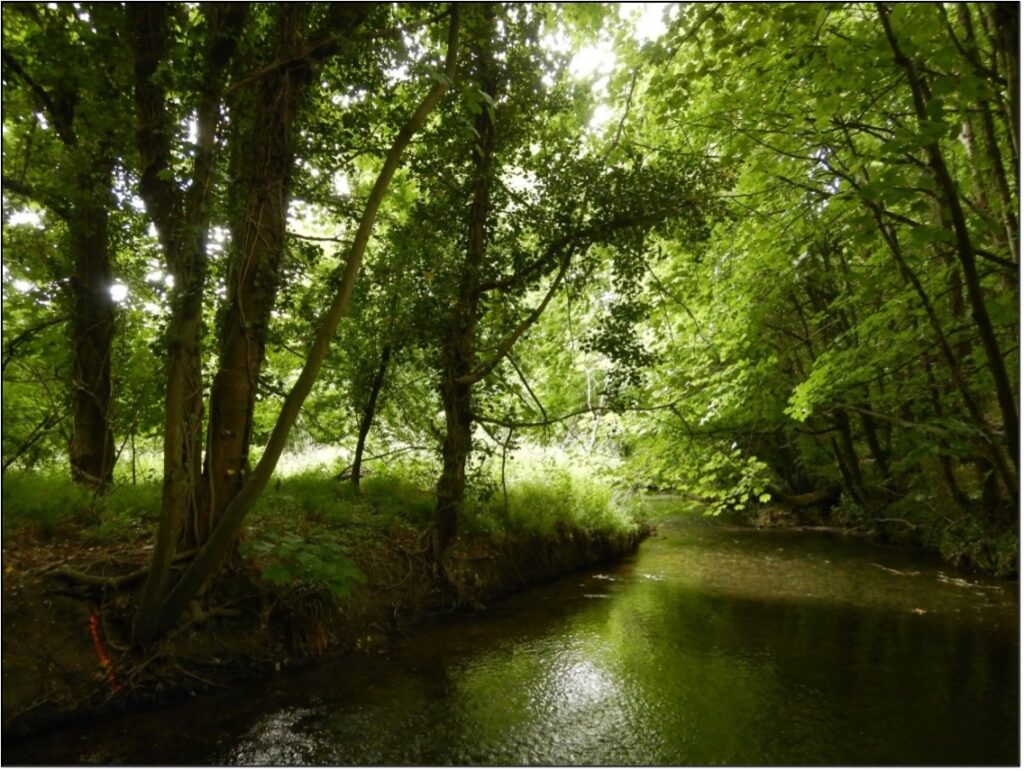
Asad Raza: Sure. I’ve put together a little summary. I feel a bit bad for the people who are part of the group right now because it’s a lot to take in. Essentially, we’re working on making a stretch of river in Cambridgeshire, England, more diverse, wilder, and capable of hosting other organisms. I’m also trying to build a pavilion shaped somewhat like a human ear. On one side, you can sit, and it acoustically amplifies the sound of the river.
These are early renderings. We’ve moved more toward a design in wood, which is the direction we’re going in now. The site is in a biotech park with a manmade lake, but it also has an ancient, microbial-rich chalk stream running through it. That’s the environment we’re working with.
The last couple of months have been tough because there have been issues with the site—figuring out exactly where we can locate the structure for legal and practical reasons, including flood zones. The planning application process is very long for projects like this. I wish it were as simple as saying, “Here’s what we’re going to do,” but there are many permissions to obtain and a lot of coordination. That’s just how society works now. It’s difficult to get things done, but maybe that’s good—it prevents us from chopping down trees or destroying habitats without consultation.
We’re currently in that phase, and I’m going to Cambridge tomorrow morning for the next meeting to determine the exact location. If we did this conversation after that meeting, I might have more updates, but that’s where things stand at the moment.
Kristine Roome: Conceptually, the idea is to amplify the sound of the river.
Asad Raza: Yes, that’s correct. The project will be located in a sparsely populated area within the biotech park, which includes large corporations like Illumina and Pfizer, as well as other high-tech companies often working with DNA sequencing and related technologies. And then there’s this wild river flowing behind them, and there’s a little village down the road. All of those constituencies are interesting to me to bring together. So in a way, this pavilion, where you could go, will hopefully bring those communities together and focus them on the ear.
I’m trying to play with this kind of microscope or lens-like function of an art experience, where the artwork is really a tool to help you connect to the river—the River Granta. I’m also trying to encourage scientific research to be done on the river because these rivers have not been studied. For example, we did some work sequencing the DNA of the water and printed the DNA of an unknown life form we found nearby with the help of one of the companies in the park. Unexpected things are happening in the project.
Kristine Roome: Were you able to resolve the part about the material? You were trying to figure out what would both amplify sound and feel natural.
Asad Raza: Eventually, we realized wood is probably the best choice, hopefully something more local, although cedar might be more resistant to insects. Essentially, it’s going to be almost like a musical instrument. Like a violin, wood resonates and amplifies sound well. If you were focused purely on acoustics, you might use very smooth, heavy cast concrete—but that would be ecologically damaging and create flood hazards. So instead, we’re using wood on stakes, with the polished wood interior functioning like a hood or resonance chamber to convey the sound. That’s the theory—let’s see if we can make it happen.
Kristine Roome: All right. I want to thank you, Asad, again for joining us as always. We can’t wait to see what’s going to happen next. Thank you.
Asad Raza: Thank you, and thanks for the invitation. I hope everyone has a good day.
Responses