
Tool Libraries and Repair Communities

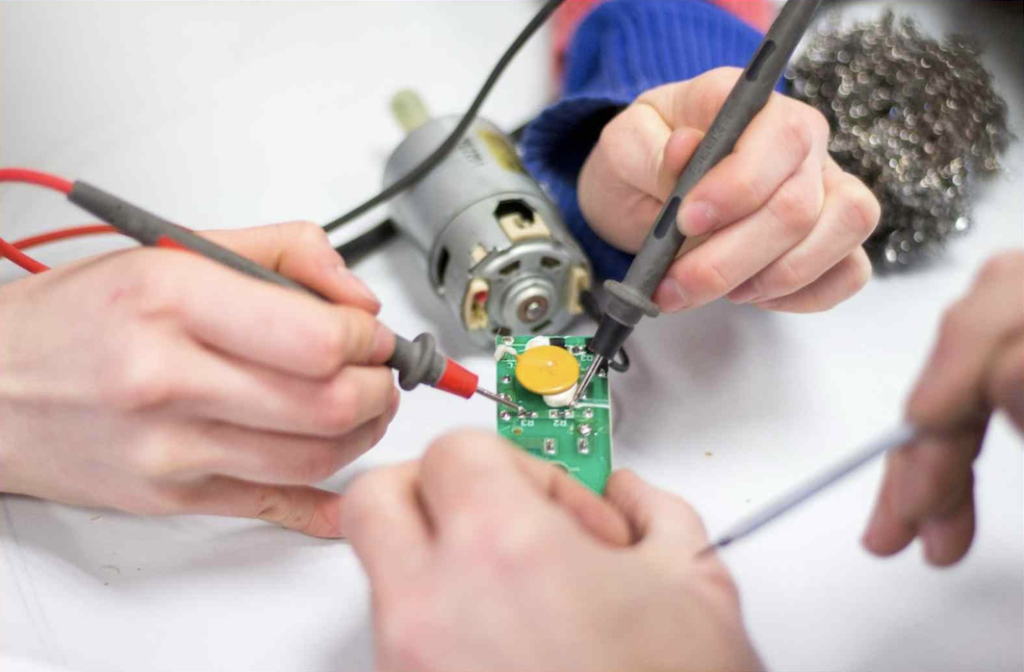
On December 2, 2025, the Ecological Design Collective convened at the Station North Tool Library to start a conversation with Jessa Wais and Blanca Callén Moreu about repair communities in Baltimore and Barcelona. Moderated by Anand Pandian, one of the curators at EDC, the evening brought together practitioners at the heart of the repair movement.
The rapid and massive cycle of production, consumption, and subsequent disposal of manufactured objects depends on the exploitation of finite natural resources and results in the contamination of bodies and terrestrial ecosystems. If this consumption happens within the framework of private and isolated property, or if disposal is accelerated by premature, planned, or perceived obsolescence, the damage multiplies on a larger scale and at a faster speed. While we celebrate institutional advances, such as the Right to Repair Act (NCSL), passed in several US states, or the approval of the EU Right to Repair directive, which serve as a legal shield for repair, we also ask about how tactics and strategies can proliferate to strengthen the self-immunity system from and for local communities. How can we share resources and knowledge to foster a culture of material repair that also repairs our community ties? In the face of this multiple toxicity derived from market and neoliberal capitalism, we can find some antidotes and “cures” in local initiatives like Libraries of Tools, Things and repair groups and communities. This event proposes a conversation between the Station North Tool Library in Baltimore (USA) and the Restarters BCN collective in Barcelona (Spain) to share learnings, achievements, difficulties, and challenges, and to imagine together how to continue to be an antidote to the toxicity of fast and individualized consumerism.
Location: The Station North Tool Library, 417 E Oliver St, Baltimore, MD 21202
Speakers:
Blanca Callén Moreu: Lecturer and researcher of the Social Psychology department at the Autonomous University of Barcelona (UAB), and member of the CareNet research group (UOC). Her work lies at the intersection of STS, material cultures, and collective political action. In recent years, she has been researching electronic waste production and repair cultures in the context of the climate crisis, through the case of repair communities and the rematerialization of telecommunication infrastructures. She is co-founder and a member of Restarters BCN.
Jessa Wais: Jessa has served as a Co-Director at the Station North Tool Library for 6 years. They manage a lending library of 3,000+ shared tools with and organize free community repair events like Fix-It Fairs. Jessa was born and raised in Baltimore and received their BA in Public Health Studies from Johns Hopkins University. When they aren’t working at the Tool Library, they organize Jewish Ancestral Skills Gatherings, and enjoy woodworking and knifemaking.
Anand Pandian: Anand Pandian is Krieger-Eisenhower Professor of Anthropology at Johns Hopkins University. His books include Something Between Us: The Everyday Walls of American Life and How to Take Them Down, and A Possible Anthropology: Methods for Uneasy Times. Anand serves as President of the Society for Cultural Anthropology, and as a curator of the Ecological Design Collective, a community for radical ecological imagination and collaboration. He lives with his family in Baltimore, where he is currently working on a new book project on decay, waste, and the crafting of ecological futures.
Transcript:
Anand Pandian: My name is Anand Pandian. I use he/him pronouns. I’m a professor of anthropology at Johns Hopkins and, like Nicole, one of the curators of the Ecological Design Collective, along with Siyu and Lindi, who are our amazing graduate fellows. We are a community for radical ecological imagination and collaboration. We’re building a network of researchers like ourselves along with writers, artists, activists, designers, really everyone who’s interested in trying to come together to think about how to build a more livable future, which is a challenge that I think a lot of us think about in a city like Baltimore. Living in the shadow, in the aftermath of a certain vision of industrial progress that went somewhere, didn’t quite take everyone with it, but also in relation to all the different communities and histories that we bring to this city. These are truly, as folks in the room have already shared, global problems with global questions at stake, and hopefully with the value of lessons from different places that we can bring to bear on this question of what it means to cultivate a more livable future for ourselves, for kids like the wonderful ones in the corner of the room here, and really for everyone, right, who falls behind us. It’s important that we have individuals like everyone here tonight who’s concerned about these questions. But institutions are also really important in terms of giving us the space to imagine what it might be like to occupy the present differently and to practice other ways of being in the world that are more sensitive and nurturing of the real forms of ecological possibility that so many of us are striving for. In that sense, we’re so lucky to be here tonight at the Station North Tool Library, really such a legendary and pivotal institution in the DIY ecosystem of Baltimore. I want to just begin by acknowledging the Station North Tool Library for hosting us tonight on Giving Tuesday with a small reminder that organizations like SNTL depend on the generosity of a larger community, and anyone can become a member. I also want to just take a moment to introduce Jessa Wais. Jessa is a co-director at the Station North Tool Library. It’s been that way for the last six years. They manage a lending library of over 3,000 shared tools and organize free community repair events like the Fix-It Fairs we’ve been talking about. Jessa was born and raised in Baltimore and received their BA in Public Health Studies from Johns Hopkins University. When they aren’t working at the tool library, they organize Jewish ancestral skills gatherings and enjoy woodworking and knife making. I want to just pass it over to Jessa for a moment before I introduce Blanca, who is also here with us from Barcelona.
Jessa Wais: Awesome. Well first of all, welcome everyone. It’s so good to see all the faces and to hear a bit about what brought you out tonight. My name is Jessa. I use they/them pronouns. The quick housekeeping would be: tool library is not the most formal space in the world, so please take care of yourself this evening. We have one bathroom through the shop, through the door, there’s a little sign. There’s bathroom on the left, it’s only one stall. There’s also water and tea there if you need a beverage. Please take care of yourself. We are hoping this is a conversation as well, so I want to hear from you. Sounds like there are folks with a lot of different experiences in the room, so excited to hear from you all as well. But, should I give the tool library 101 now or do you want me to do that later?
Anand Pandian: I might invite you to talk about it in a second, but if there’s anything you want to say at the very outset, you can.
Jessa Wais: No, just excited to be here. I guess the personal thing I’d share is that before I worked at the tool library, I had very limited experience with tools and making. I get asked a lot about how I ended up here. The long story short is an accident, which is straight out of Hopkins, I was supposed to be teaching a public health summer program and there was a last second change and they threw me into a makerspace, teaching woodworking to high schoolers, which I had never been in a wood shop before. They were like, “Don’t worry, we paired you with the woodworker, you’re gonna be fine.” I was very nervous but also very quickly fell in love with woodworking. Working with high schoolers in a makerspace is amazing because there are spinning blades that keep their phones away. That was one of my favorite parts. I was like, wow, my classroom management is this blade. Anyway, that came out weird, but that was kind of the start to my woodworking journey. Then throughout the year I found the tool library. I worked with high schoolers in the space for a summer and just fell in love with the space. I’ve been here six years now and have developed my own practice. Running Fix-It Fairs is, I love a lot about my job, but organizing Fix-It Fairs is my number one favorite thing. The repair brain, once you start the repair brain, it doesn’t stop. I noticed before I started working here, I was very subject to the “it’s broken, end of story. It’s broken, there’s nothing I can do but get a new one.” Working at the tool library is where that part of my brain of “well, what is wrong? I need to get to the bottom of it” developed, which I felt that energy from a lot of people in this room. It’s a muscle that I hope to just personally continue building, and I love all things repair.
Anand Pandian: Thank you. Thank you so much Jessa. Everyone who’s been to one of the Fix-It Fairs here knows that it ultimately isn’t just about the broken things that people bring, it’s also the fact that you can gather together and share knowledge, share expertise, look at stuff together, tinker together, and really leave one of those events with a sense not only of what you can do differently with your things, but also what you can do differently in the company of others, right? Because so much of the way in which our market economy is organized basically tells us that as individuals, we can buy what we want, and when it doesn’t work the way we want it to, we can buy something else. We all know that that isn’t a sustainable way of living and being. The beauty of events like Fix-It Fairs is that they do bring people together to share knowledge and expertise and some collective vision for some other way of being in the world. That is precisely what we’re hoping to get into with this particular conversation. We’re here at a tool library, but we’re also thinking about repair communities. We’re thinking about a tool library like this one here in Baltimore and the repair community that this one has helped build here in this city. But we’re also trying to think between Baltimore and Barcelona. For that reason, we’re incredibly lucky to have with us today Blanca Callén Moreu, a lecturer and researcher in the social psychology department at the Autonomous University of Barcelona, and a member of the CareNet Research Group. Her work lies at the intersection of science and technology studies, material cultures, and collective political action. She’s written a lot of important work on those topics, but she’s also been researching electronic waste production and repair cultures in the context of the climate crisis, looking at repair communities and the rematerialization of telecommunication infrastructures. But also personally, she’s a co-founder and a member of an organization based in Barcelona called Restarters BCN. When I first learned, I’ve begun doing a little research myself around some of these questions in Barcelona as an anthropologist, when I first learned about this network that Blanca’s part of and had a chance to see some of these community spaces myself firsthand, it was really kind of astonishing to me to see the immense amount of interest and activity that repair events drew out of the community in different parts of the city, but also the infrastructure of support for that kind of work in that city. I was just thinking a lot about how different it felt coming from Baltimore, knowing of all the interests that people have in endeavors like this, but then seeing it actualized in a different city with an entirely different kind of social and political backdrop behind it. Since then I’ve been thinking, wow, wouldn’t it be interesting to try to have a conversation between these two cities or between folks in these two cities about what it’s like to pioneer this kind of repair culture and to try to build community around these commitments to repair. When it became possible for Blanca to come here this fall to Baltimore, it was kind of a no-brainer to try to make something like this happen. I’m so grateful to have you here for that purpose. Blanca, thank you so much. I want to just, as one other way to kind of kick this off, just read a bit from this event description that gets at some of the themes that we’ve been thinking about. The rapid and massive cycle of production, consumption, and subsequent disposal of manufactured objects depends on the exploitation of finite natural resources resulting in the contamination of bodies and also terrestrial ecosystems. If this consumption happens within the framework of private and isolated property, the damage multiplies on a larger scale and at a faster speed. While we celebrate institutional advances such as the Right to Repair Act or the approval of the EU Right to Repair Directive, we can also think about how tactics and strategies can proliferate to strengthen the self-management that communities, local communities, can practice. How can we share resources and knowledge to foster a culture of material repair that also repairs our community ties? In the face of the multiple toxicities of market and neoliberal capitalism, can we find antidotes and cures in local initiatives like libraries of tools, things, and repair groups and communities? It’s with those kinds of questions that we’re trying to gather today to think through lessons from this repair work that are happening in these two cities. I’m gonna start just by asking each of you to speak a little about some of these questions, and then I hope, just given the really interesting set of people that we have around the table, that we can make it more interactive as well. Given that Jessa has given us a nice introduction to the space that we’re in, Blanca, can you tell us a little more about the repair community in Barcelona? Maybe you can talk about Restarters BCN, which is the organization that you helped co-found, but also give us a little more context as to what people are doing with regard to repair.
Blanca Callén: Sure. Restarters Barcelona, we are a collective that we set up ten years ago in 2015 because we knew about a mother project called the Restart Project that started in the UK, in London. In my case, personally, at that time I was doing research specifically about the informal and community responses to electronic waste. That’s how I knew them. I had one week left before going back to Spain, and I wrote saying, “I want to learn from you. Can I spend a whole week with you learning from you and everything?” When I came back to Barcelona, they put me in touch with another guy who at that time was working for HP. But he was a good guy. We organized the first assembly at my house with a bunch of people, some of them, for example, the person who repaired my own computer, who one day told me, “Okay, if one day you decide to set up anything, just let me know.” We were just random people that almost didn’t know each other. We organized the first Restart Party. We call them Restart Parties. These are public events, free public events, where we all are volunteers. We host and welcome the participants and we try to make a very easygoing and very community-oriented moment. We organize there is one role of organizer and hosting and another of repair. We organized our first Restart Party in September 2015. After that, we have only been responding to demands of Restart Parties because word spread in the city very quickly. Because of the city, I feel that Barcelona also has a very strong history of self-managed projects, anarchism, and social and solidarity economy. Especially after the last mayor who came from social movements, it was a revamp somehow of this culture. After this time, we just responded to the demands of organizing Restart Parties. From, apart from this activity from 2019 onwards, we have been giving support to the creation of new small neighborhood communities, repair communities in the city, but also outside the city in Valencia as well. Somehow we already have a kind of know-how that we share with anyone that brings to us and asks about some kind of support and learning.
Anand Pandian: Amazing. I had the chance to attend one of these Restart events with you one Saturday morning, I think it was last year, not this year. I was really struck by the range of things that people brought in that day, but also the fact that most of the folks that came that day were elderly. You could feel something that Blanca has actually written quite a lot about in her own research, that when people are working to repair things, they’re also repairing social relationships. There’s a relationship between the brokenness of these things around us and the brokenness of our society, which is quite important and poignant to think about. But another thing that I remember from that occasion is that we were standing there in Poblenou looking at this tool library there, and you were telling me about Baltimore. You were telling me about the Station North Tool Library, and you were asking me questions: “Oh, you come from Baltimore, what do you know about them?” I was so struck by that because to me, coming from the United States, Barcelona is like this eco-utopia, everything that isn’t possible, you think, or is on the very edges of what might be possible, it’s like the city has already done that and has moved on to something else. Maybe not quite, I know you’ve got your struggles, but it feels like quite a lot. But to be there and to have you asking about this thing that happened in Baltimore was really extraordinary. If we could actually go back to Jessa for a moment, how did we get to the existence of this, at this point, this massive sort of repair institution now that clearly has a global impact, an imprint, if people are talking about it elsewhere?
Jessa Wais: Sure, sure. I also want to say, I love that you call them Restart Parties. You bring the fun into it. We call them Fix-It Fairs, because we’re like, repairs should be fun. I love, I’m like, you guys take it a step further. This is a party.
Blanca Callén: We party and people party.
Jessa Wais: I’m picturing y’all sipping sangria in Barcelona. But I know some folks were new to the tool library, so the very quick tool library 101: we were founded in 2013, so we’ve been around for around 12 years now. When we first started, we were just that first room you walked into, the tool lending library, very grassroots DIY project. Almost all of the tools were donated, really volunteer-powered. Then we got a startup grant that allowed us to really build out our infrastructure. Quickly we realized that people don’t just need access to tools. They need space to use the tools. Folks need guidance on how to use the tools. We wanted it to be a space for really for Baltimore, not just for folks who are already confident using tools. We wanted people to come in and be like, “I’ve never used a drill before, but you know, I just moved into a new place. I’m a renter. How do I hang this shelf?” A very common first tool borrow is a level, a drill, a stud finder, specifically to hang a shelf, to borrow a ladder to reach one thing once. But I don’t want to own a ladder. I don’t have space to store the ladder. We knew the lending library was very popular immediately. We were able to get grants to buy really top-tier tools to expand our inventory. Then we built out the wood shop, which you saw. That’s our biggest classroom space now. We have three educational spaces, so you’re seated in our crafts and home repair classroom. Everything from we have electrical back there with the kiddos and Nicole, plumbing, wall repair, all sorts of classes. I know some of you have taken classes. Then next door we have a small metal shop where you can learn knife making, one of my favorite classes, as well as knife sharpening. How do you take care of, that’s a newer class, how do you take care of the tools you already have? This tool library 101: it’s the lending library, so you borrow tools, sliding scale, anyone can join. We don’t want anything to be a barrier to getting the tools you need. Classes. Then the third bucket is open shop. You do have to be a member, but you can come back to the space on Sundays and work on your project as well. That’s a little bit longer of a tool library 101.
Anand Pandian: Tool library 101.5. For those of us who are new to this phenomenon, tool library, right, library. We’re all accustomed to going to a library to borrow books. Can you just walk us through the idea of a tool library? How did we even get to this point where we have libraries of tools and not just books?
Jessa Wais: Totally. A lot of times we’ll be like, we’re like a book library, but tools, and we have books and there’s other stuff. I think the simplest version of it is this belief that we don’t have to own every item we use. In fact, there’s a lot of items that lend themselves very well to being shared, and that when we share our items, we all have more. I think that’s at the core of a lending library. I think something really beautiful about libraries of things: one of our old-school volunteers, he’s been a volunteer and a teacher for 10 years out of the 12 years we’ve been here, Keith. When I first started working here, I just remember talking to him about what keeps you coming back to the space? I’ll never forget what he said. He was just like, “You know, I’ve had my cynical activism days, and I still am an activist, but the tool library is one of the first spaces that wasn’t just anti-capitalist, it was pro something else.” It showed really another smarter way of being. Something I say too is, like, it sells itself. It just makes sense. Everyone pays into this thing. It’s not a charity model. It’s not like “we’re helping you.” It’s just like, no, we’re a smart way of Baltimore City sharing resources. I think that’s something that really resonated with folks, and you see people, our membership has grown so much. We’re actually, the truth is, we’re struggling to keep up with the growth in membership. In under two years, our membership doubled from 1,200 members to 2,400 plus people. You might see, our physical space didn’t grow. We’ve tried to grow our inventory, but we have been for years being like, someone needs to start another tool library. We need more tool libraries. The last thing I’ll say is, along with this idea of the sharing economy, we are really big on sharing resources as well. We’ve done a lot to compile what has made this space successful. People don’t realize Baltimore has one of the biggest tool libraries in the world by square footage, by number of classes. We have 30 plus classes, which is we haven’t found another tool library that has as many classes as this tool library. I was telling Blanca before the event we’re working on really codifying the curriculum so it can be open source. We share curriculum with other tool libraries. We’re like, “Here’s how we teach electrical 101, do with it what you will.” We want this resource out there. We’ve also been leaders in the Lending Library Alliance movement. We’re trying to get tool libraries across the globe really together just so we can continue building power, sharing resources and things like that.
Anand Pandian: Amazing. Thank you so much. I feel as I was listening to you, Jessa, I was thinking about some of the things that Blanca had said about Barcelona, about this long history of collective organizing, of socialist organizing, of anarchist organizing, of just all kinds of movements for mutual aid and collective self-managed spaces and resources as an alternative to conventional forms of capitalist development. You are participating in the creation and propagation of these alternatives, but you’re also studying them. I’m curious, how does what Jessa is saying sit with you? Is it similar? If I’m to ask the question, what brings people into spaces like that in Barcelona? What is responsible for the fact that we see a tool library not just in one place, but now in multiple places in the city? We see it spreading. What is it that’s drawing people to this way of doing things in Barcelona?
Blanca Callén: I think that the social base of grassroots movements and social associations, like collectives, are very strong historically and culturally. For example, in Barcelona, every neighborhood has their own parties once a year. A lot of activities are self-organized, also part of the Catalan culture. There are the castellers, which are like human towers, which is a very physical but also metaphorical way of dealing with all the things that we are talking now about, how to live together and how to sustain together and how to resist against contexts with no support or not. I think that also historically in Spain we didn’t have maybe a very strong state. I suppose that a way of compensating somehow is to have a very strong grassroots movements. Also family networks. Everything that has to do with the informalities are quite strong, but especially in Barcelona because of the history that I mentioned before. We see that we are not many people, many volunteer people, but the people who are volunteers are everywhere. They don’t only volunteer here, but in many other places. For example, I’m thinking of one of the repairers who goes to almost every Restart Party. He’s also the technician of one anarchist radio, but also he’s part of the movement to protect the cats that live in the streets. He’s also in the army. It’s like, wow, you are my hero. There are these kind of super strong figures, which is also a difficulty because sometimes I would prefer to have more people and more distributed tasks than so centralized or so focused on so few people. But also, as you said before, we have a lot of power from retired people. In fact, when we started, well, we were at the beginning only organizing Restart Parties, but then we decided to apply for a grant to make a pilot to start some local communities within two neighborhoods. We had the hypothesis that, okay, where can we find the repairers? We thought maybe young students that are studying electronics or electricity, whatever, or other people who have a lot of time and who know a lot of other things. The first hypothesis, we completely failed. Young people are anywhere, but not especially Saturday morning. But a lot of elder people around, retired people, came and they are amazing. They’re super passionate. I think that one of the things that moves people to be part of this is that they are obsessive with repairing things, with learning things, which is a super strong and positive thing. But at the same time, it’s a critique, a self-critique that we make ourselves. They are so, they enjoy so much and they focus so much on the repair that they forget that they have someone in front of them who they have to explain something to. Because for us, it is as important to repair things as learning and sharing and pedagogy. Sometimes this pedagogical side is forgotten because repairers are so enthusiastic, so passionate, so obsessed that they lose the world. Then, so they’re very fond of this.
Anand Pandian: It’s interesting. It strikes me that there are certain things that have to fall into place to really form a repair culture. You need that interest in repair to begin with. You need the experience to draw on, but you also need a way to propagate that knowledge, to share it, right, so that some people are learning from other people. But you also need a space in which all of this happens. You need institutions, you need support. You were just talking about writing grants. I’m wondering if you could talk a little about that side of it as well. Jessa, you used the word or the phrase “anti-capitalist,” and clearly there’s something going on here that pushes against these dominant logics, but is it anti-state in the same way? Or is there a different kind of relationship between the public institutions and what’s happening in these spaces? Can you help us understand that side of it better? What does it take to actually sustain a vibrant repair ecosystem in a city like Barcelona?
Blanca Callén: I think it’s a very important question. In our case, we started as an informal collective, and we decided to move into and transfer into an association, a formal association, because this way we could apply for grants and we could receive some payment, because sometimes people wanted to pay us. We thought that it was a good idea. After more than five years, we have decided to stop being an association and go back to being a collective, an informal collective, because the bureaucracy is a nightmare. It’s a waste of time. It’s a waste of money. We are completely free and all volunteer, but we started to receive money because of donations, because people wanted to. Keeping us as an association was demanding that we pay monthly to a cooperative to deal with the money that we don’t have. It was quite tricky and too hard. In our case, we decided that the best formal shape was to be informal, but it is true that we have a lot of alliances with many other spaces. For example, in Barcelona, the network of civic centers that belongs to the city council is super strong. It’s a very good base. Many of these centers, many are run by companies, so companies that are dedicated to social issues, but some of them are run by assemblies and communities. The management has different models. We have a lot of alliances with these spaces, or with organizations or groups of people that make their activities in these spaces. For example, we don’t have a space. We have a trolley, a shopping trolley with the banner and the tools. We have like three shopping trolleys that move around. It’s very important to collaborate and to have alliances with other groups, and to minimize the needs that we have in terms of space, in terms of money, in terms of everything. We make Restart Parties for free, but for example, at some point we receive some demands from institutions. We decided in an assembly that, okay, at least we don’t have to pay money from our pockets to move to the places. If you are an institution and you have a budget, you have to pay us, not personally, but as a kind of base for the project. We can help other communities to grow up or to buy tools or anything. But if we organize these parties in social centers, these are completely free. We started with this kind of double fee. It’s very important, your question. Barcelona is cool, but not so cool because, for example, the city council has some grants, but they don’t give you a hundred percent of the budgets. We think that the best model, there is only one example in Barcelona, which is a tool library that has also a repair community. We think that the best model is a public-community model. A management done by community people because it’s self-organized, but the money comes from the administration. Because the ones who know more about the territory, about the needs, about what happens in a neighborhood are their own community. But the one who has the money and the resources is the city council. We think that this combination should be the best option. There is only one example right now, but this example is where everybody is mirroring and looking at as a kind of hope.
Anand Pandian: Thank you, Blanca. I’d love to bring that question back to Baltimore, to you, Jessa, because one thing that I hear Blanca saying is that there’s a certain kind of symbiotic relationship with the local community, that it’s this relationship with the local neighborhood, with the people of that neighborhood, with the institutions that represent that local place, that these are the kind of networks that these libraries are depending on but also feeding. That’s the foundation in some ways for these local repair communities. How would you describe it here in Baltimore? What is the fabric that keeps something like a tool library going and keeps this as a kind of viable way of doing things as an alternative?
Jessa Wais: It’s a juicy question. Also, I need photos of these repair trolleys because that is one of my dreams, to have little mobile vans that can pop up to do repair. We’ll talk about that after. But trolleys, it’s interesting being a nonprofit. I think historically running free repair events costs money, and it’s so critical that we keep those events free and as low barrier as possible. But we also want to be really successful. We want our fixers to have the tools they need. We want to have common consumables, like when you come in to get your lamp fixed, we want to have all the right parts for 20 different types of lamps. We have invested a lot of money in our tools and consumables. We had around five years of running Fix-It Fairs and every time we ran them, it cost the organization money. We were in the red, but it was worth it because it’s so important to our mission and what we do. But I definitely got the sense that it was really hard to commit to what a Fix-It Fair schedule would look like. Every time we run a Fix-It Fair, the number one question you get is, “When’s the next one?” As staff you’re like, well, we have to check the budget. It was hard because we’re doing it on top of all of the core services that we need to prioritize as a lending library. What was magical for us, and for us, it was critical to be a nonprofit so that we could do this, was through partnerships with city agencies. We have two big partnerships. One is with the Enoch Pratt Free Library, which made a lot of sense for us. They’re a partner we’ve always wanted to connect more with. That was the first time a Fix-It Fair was revenue-generating where the staff got paid for their time organizing Fix-It Fairs. It was really magical. Then also the past two years we’ve built, I’m really proud, we’ve built a partnership with the Department of Public Works, with DPW. That was a whole other scale of support where we got tens of thousands of dollars, which is a lot more than we’ve gotten in the past. That was really big for us to be able to spend money to build that inventory of tools, consumables. I got to buy nice swag for all of our volunteers. I basically want to make a Fix-It Fair a volunteer’s favorite day of the year. Maybe Kimberly, Dara, Mecca, and VK can attest to how we do with that. But we found that we have a bit of a cult following from our volunteers, from participants for sure. But you used the word “hero” to describe one of your fixers, and that is something that really resonates because it’s like, what better gift is there than to not just gift the power of repairing someone’s item, but to also give them the gift of bringing them into that world? Because a lot of us haven’t been brought into that world. I think in terms of sustaining the movement, the money has to make sense for us to make it something that we can commit to year after year. Right now we’re at a point where we commit to two a year. We are exploring with Enoch Pratt doing smaller-scale Fix-It Fairs, which are a lot less work to organize. We had our first mending clinic, so it was just clothing repair. We were able to do that off-site. I see Kimberly mending at the table. I love that, adding to the vibe of this event. Exploring what are other creative ways we can build repair in Baltimore that don’t cost so much money. We’re trying to be creative, but we basically want to create an environment that is so exciting and fun and successful. Our last Fix-It Fair, we had over 200 people. We had around 300 items and we fixed over 80% of items in one day, which is pretty wild. People also bring in stuff that they don’t make the parts for anymore. We had no chance, you know? We’re really proud of having an event that just feels good. Even if you are in the 20% and your item didn’t get fixed, hopefully you learned something. But we just want to make it irresistible. That’s the goal.
Anand Pandian: Amazing. Alright. I’m gonna ask one more question to both of you and then maybe invite you to ask each other questions and invite other folks to come in as well. I also want to just take a moment to say that Lindi might be taking some photographs now and then, and if anyone wants not to be featured in a photograph, just let us know. That’s not a problem at all, and we can figure out the video as well. Just given what you were talking about in terms of the energy that you want to bring to these events and that sense of possibility, I want to think about what the promise is of a tool library and of a repair community or this repair movement. This is part, for us with the Ecological Design Collective, of a series of events we’re doing this year called Antidotes to Toxicity. We’ve been having different kinds of conversations in different kinds of spaces about, well, different kinds of toxicity. We’re taking that term pretty widely and loosely because there’s a lot that’s broken, to be honest. There’s a lot of harm out there, to be honest, right? There’s a lot to be careful about. There are a lot of hazards that we need to be thinking about and organizing against. Chief among them is this way of organizing our economies that is founded on this sort of endless propagation of disposable things. It’s got to feel hard sometimes, right, thinking about that and dealing with these things one by one, almost, right, at each of these events. How do you feel about repair communities and tool libraries as an antidote to the toxicity of this time? You’re both very hopeful in the way that you talk about it, and that is, I think, not something that all of us feel all the time. Bring us into that space and that feeling a little.
Jessa Wais: Sure. Well, for me, I think being born and raised in Baltimore, going to school at Hopkins, this public health world where so many folks were drawn to global public health, I maintain hope by focusing on Baltimore City. I think Baltimore is a really special city for a lot of reasons, but I think it’s the best place to do public health work, the best place to do equity work, the best place. We have housing stock that’s so cool. Other cities don’t have housing stock where you can say, no, our population could grow without displacement. I think that is so motivating. Obviously we also have gentrification and there’s plenty to be pessimistic about. But it’s the most beautiful city for repair, is how I feel. It helps for me, I think, thinking locally, believing in a ripple effect. When I’m at a Fix-It Fair and I see the “aha” moment in someone, just getting to witness that, I will hold onto that more than I will hold onto some of the other feelings. You just have to, I don’t know, I feel like to be hopeful is a responsibility of all of us, of leaders, just making sure that we believe that other worlds are possible. I think that is something my Judaism has taught me a lot about, Olam Haba, the world to come, the power of repair as a pathway forward. We know that repair has always been a part of human culture. We’ve always been breaking things, we’ve always been fixing things. As long as things have existed, they’ve broken. We know it’ll be in the future, but how are we intentionally cultivating that future is something I’d like to try to focus on.
Anand Pandian: Wow. Very powerful.
Blanca Callén: Well, following with Jessa’s thoughts, I think that in our case, for me, one powerful thing is that this kind of hope, because hope usually is something for the future, is already happening right here, right now. After going to a Restart Party, sometimes you feel like, wow, it’s Saturday morning, now I have to go there. But then when it happens, it’s like, wow, it’s a bump of energy and hope in humanity somehow after being part of one of these events. I think that one of the more powerful things that happens there is that many people tell us that suddenly, just because of opening a device with the help of someone else, they lost fear of the technology or lost fear of opening new things. Or for example, some people say something that you said before: “Wow, now I have started to think about the things that I have at home and I can try to repair.” It’s a kind of kickoff moment to make this repair culture something inside and part of you. That’s why I think that we are trying to create a kind of repair culture because in terms of numbers, in terms of quantity, if we count the number of electronic devices that are created every day, what we do is nothing. First of all, but when you see the statistics of the percentage of repair, we repair almost 50% of the devices that people bring, and 20% more are devices that needed some spare part that was not there. But so they are repairable. Okay, quantitatively we do something, but it’s nothing compared to capitalism. But something happens in the people, in the culture, in this kind of hope that is being performed right there, in the fact that you realize that despite the Right to Repair Directive, and maybe the institutions are more sensitive to this, these kinds of movements are just taking the right to repair as, as we said one day, as a kind of natural right of anyone. I don’t have to wait for others to repair for me, or I don’t have to wait for the institutions to do something for me. Also the fact that maybe I don’t have any idea about repair and I don’t need it because we can do it together. We say that thing: they wanted us isolated, but they will find us together. Because we are doing this together, we can repair. It’s also another way of going beyond the isolation and individualism. Even information is individualistic, you study something and it’s your own individual personal career, but these events are hacking this kind of mindset. I think it’s powerful.
Anand Pandian: That’s amazing. I also wanted a quick stats check because I know you said the 50% and I’m like, we cheat a little compared to doing just electronics, because it’s just electronics, right?
Blanca Callén: 50% is incredible.
Jessa Wais: That is our hardest area, which is the tinkerers, the electronics zone, is around 50% for us too. It’s the mending that has a 94% rate.
Blanca Callén: Mending.
Jessa Wais: Then we also do knife sharpening, which has a very high rate of success, except someone always brings like a serrated bread knife that we don’t have time to sharpen. I’m like, ah, we almost had a hundred percent. But anyway, a stats check in that 50% for electronics repair is as good as you can kind of get with the electronics world.
Anand Pandian: Amazing. Do you want to ask each other questions or make observations? I also want to bring other people in, but maybe we could start with the two of you thinking between your spaces.
Blanca Callén: I’m curious because one of the critical things for us is that the kinds of people that reach us are very specific people. I suspect that those who could get more benefits, maybe because of economic issues, are not arriving. In our case, for example, in the case of Restart Parties, one prototype is the old lady who lives alone and needs someone to fix the device, and also like middle-class people, lefties who are already sensitized about these topics. But for example, it’s like, okay, how to arrive to other people beyond these, young people, for example, migrant people, considering that in Barcelona there are a lot of migrant people, or directly poor people that could super benefit from this. I don’t know what your profile or prototype of user is, or how do you reach a variety of people?
Jessa Wais: It’s a great question and an area that we definitely have room to grow in, just making sure that more people have access to Fix-It Fairs and repair events. For us, I think partnering with the public library system was really helpful. When we did the mending clinic in southeast Baltimore, that’s a neighborhood we had never done programming in, ever. We heard from people that came to that, like, “I’ve heard of you, but I can never make it all the way over there.” The ability, and it sounds like you all have the ability to change locations and to pop up in community centers, I’m sure that goes a long way just in geographical proximity. We have definitely had success with classic door-knocking, canvassing. I will be pretty intentional about where we door-knock or canvas. I’ll be like, “Don’t just put this flyer up anywhere. Maybe let’s put it places that we don’t have any members. Let’s go to East Baltimore, West Baltimore.” Being intentional about that. Then in Baltimore, maybe I don’t, I’m not sure what it’s like in Barcelona, but faith communities are really big. Getting, even if it’s an email to a church or something like that, we’ve definitely seen that that’s impactful. I’m thinking, what else? Kinetic sculptures.
Blanca Callén: Kinetic sculptures. Oh, was that helpful?
Jessa Wais: That’s how you found us. That’s how you found us. Community events. I’m thinking about it was the bicycle.
Anand Pandian: Oh right. We were there, we were there at the sculpture race.
Jessa Wais: I do think we could do better. I wish we had more Spanish-speaking fixers. That’s something we could promote. I will say we do, I’m really proud that our fixer squad continues to get more and more diverse age-wise, racially, gender-wise. When I first started it was almost only older cis white men. That’s been a community that continues to change. Something I’m really excited about is having more pathways to learn how to be a fixer because it is an honor to be a fixer. I’ve noticed that folks who aren’t cis white men take a lot longer to be like, “I could be a fixer.” They’re like, “No, no, I’m not a fixer.” I’m like, “Yes, you are.” I think our fixers do a lot where they’re really proud of their role, so they share it with their communities as well, where it’s like, “Come, I’ll fix your item, come to this event.” The more folks you have that are fans of the event, but good old, for us, good old door-knocking and canvassing, because you get to meet them and be like, “I’m gonna be there.” I’ve noticed that there’s a lot of skepticism in Baltimore about a free service like this. It’s like, “What’s the catch?” I’m like, “No, we’ll just try to fix your thing for free. That’s how it works.” It’s my favorite thing to door-knock and canvas about because I’m not selling anything, I’m just telling you about this cool thing. I think the one-on-one conversations go a long way in shifting someone’s perspective. Do you have a question for Blanca?
Jessa Wais: We talked a bit beforehand about pros and cons of being this informal collective or less formal collective versus a more formal association. I was curious about your relationships with the community centers or the physical spaces that you pop up. I’m also always fascinated about to what degree do you provide tools and consumables versus asking your volunteers to provide the tools, asking participants to bring parts, which we have struggled with. We struggle with people reading that or knowing what part to bring. But I’m curious about any of that. I’m curious how you do it.
Blanca Callén: With the spare parts, we don’t have spare parts except for some, I don’t know the word in English, very, very tiny, cheap things. But basically we don’t have spare parts. When people register in advance their device, we ask them, “What is happening with this device?” This gives us some clues about what might be needed. For example, in the case of a broken screen of a telephone, it’s clear that you need a new screen before coming. We get in touch with that person saying, “Okay, if you come to repair, be sure that you buy in advance your screen spare part.” Sometimes it happens that because of that we cannot finish the repair in just one session. We direct the people to the next party or to one local. This is an institutional administration project, which is super cool, which is called Millor que Nou, Better Than New, a repair project that we visited in Barcelona.
Anand Pandian: Yes.
Blanca Callén: Which is a stable, permanent place where people, similar to the workshops, where people can go there and be guided by some professionals in different areas, like sewing, in woodworking, in many different areas. We collaborate in this way. In terms of the tools, it’s very curious because the grant that we got with the city council, we dedicated a big part of the budget to buy like a basic good bunch of tools apart from the shopping trolley, inside the shopping trolley. But then we realized that the repairers are very attached to their own tools and they bring their own tools. Sometimes we move the trolley without too much success because they all bring their own tools. We realized that maybe it was not an expense that we needed. We have it.
Jessa Wais: Interesting. Wow. Great.
Anand Pandian: Awesome. Alright, well this has been amazing to listen to you both. Thank you so much. We do have a little time for any other questions or comments from folks who’ve joined us. Thank you all so much for being here. It is really exciting to be able to have a conversation like this at the tool library.
Audience Member 1: I guess we can try this since I’m sitting right here. I actually have not attended a Fix-It Fair here because I’ve never been here when they’ve happened. But I did go to at least two of the Restart Parties in Barcelona. I think when you were each talking about sort of the model that you have for that, I was struck by the idea that, Jessa, you’re talking about trying to make it this irresistible thing, and also in Barcelona, there’s like three or four a month. It’s a very different model. It’s the three Restarters who come, the repairers who come and they go. It has that popup feeling versus having it be this big formalized event. You mentioned the Enoch Pratt sort of popup thing. I’m just curious, I think the US likes to do a lot of big party-type things even though, Barcelona’s the one that uses the term “party.” But I think there’s a part of me that wonders if more of the popup model, if more of the, we don’t need t-shirts, maybe you do and maybe your volunteers really do want that, but what are the things that actually draw people in and keep them that are maybe not as necessary for the big budget? I don’t know. I was just curious if either of you had thoughts on that and just how having more, does having more opportunities to do this also create a stronger community because it’s happening more than once a season or whatever? I don’t know. That was my question, sort of.
Jessa Wais: No, it’s a great question and it’s something I think about a lot because it is so much work to do a Fix-It Fair at the scale that we do it. I think there’s something special about being able to meet people where they are with such a diversity of items. That’s something that I just couldn’t imagine doing at a smaller scale. Like we have instrument repair, we have clothing mending, we have a family zone with kids’ activities, so that, and we have sewing machine repair in particular. We build this, fixer roster for something like that. I could imagine doing more of them by just picking one type of repair. I do think that more that are good would be better than less that are perfect, like for the movement. I personally agree with that sentiment. I think for us as a nonprofit, the truth is just like our calendar is hard. We have so many events, we do so many other things that aren’t repair events. I’m kind of personally the one, and my team loves repair events, but I kind of, we have to really fight to include it kind of in what we do, even though it makes so much sense. I would love to see more DIY repair events pop up. I’m really interested in my personal position of this, of like, I know 60 plus handy people and I have people come to me with personal items they need repaired and I want it to be more dispersed. I think we’re basically, we’re starting to think more about that. We recently put out a survey to our fixers to ask them, like, what is your capacity? Like, how often, if we had a bunch of these, how many would you be able to attend? We heard very different things, but there are people that want to fix more items and there’s plenty of broken items. Someone needs to connect those dots. The tool library could do it better, I’m sure. I think we’re also hoping that other people want to step up and connect those dots as well.
Blanca Callén: I was going to say that we try to be more formal, but we don’t know how to make it. Part of that grant we dedicated to getting some t-shirts and some badges. Like, okay, we have to wear our own t-shirts so people could recognize the Restarters. We forget to wear the t-shirts. We are much more clumsy than I think. I remember one time we had a meeting with someone from the city council that said, “Wow, we love what you are doing. We would love you to make like a big event in one big avenue in Barcelona.” We imagined with a lot of tables and we said, “No, we are not that. We don’t want just one big event and then nothing. We don’t want to scale up. We want to proliferate.” We dream of a community group in every neighborhood, in every village, in every city. That’s why we prefer, like, maybe there are small Restart Parties. Maybe the biggest one is 15 people coming during three hours, but we know that the stable communities organize once a month. If there are two or three communities, we know that, as you said, in the city, there will be two for sure in a month. Also at some point we discussed the possibility of going beyond electronics, like including sewing and bicycles. Wow, it would imply a lot of much more work because to coordinate much more people to be sure that there will be at least one of each area at every party. We said, no, we prefer to focus on this because we all are volunteers. At some point we decided, okay, now we have arrived at some point that either we get professionalized or not, or we take one step back and we keep like we are. We decided this somehow.
Audience Member 1: Thank you. I have the bag though.
Blanca Callén: Yes. I use the bag. We made the bags. We said that we will sell bags. We are bad sellers. We are bad. We bought some, how do you say, we just like to put to put coins, savings.
Audience Member 1: Piggy bank?
Blanca Callén: Piggy bank, yes. We got in a shop a robot shape and we said, wow, we have to put this in a very visible place so people could donate. We forget this. Real, our best enemy is ourselves.
Anand Pandian: Amazing. Any other questions or comments?
Audience Member 2: I’m curious, from the general public perspective, what do you need from the Station North Tool Library? What are your needs right now in terms of, like, do you need more funding? Are you applying for more grants? Do you need more fixers? Do you need more tools? I’m sure you could list off like 10 things and so I’m asking you to do that.
Jessa Wais: No, I’m trying to think of a more creative answer than more funding. That’s the real answer. I think that where we’re currently at, and it’s something I think about a lot, is we have a small staff team. We have three full-time, one part-time staff member. Then we have 70 regular volunteers. Then we have 60 fixer volunteers that are, some of them are librarians too, some of them fix our broken tools, some of them, like Kimberly, only come for Fix-It Fairs thus far right now. It’s a Fix-It Fair volunteer. We have a lot of fixers. I think the hard thing for us right now is we are pretty reliant on staff to do the organization. It’s funny hearing some of what you’re sharing because we also try to do that of vetting the items so people don’t bring stuff that we can’t fix. Hearing your point of, like, I think being a community resource and feeling like the tool library’s name is on something makes it feel like we want this really high bar, and to the community piece, like we try to call every fixer and talk with them about the culture of this event because we don’t want someone to come and be made to feel dumb that they didn’t fix it themselves or something like that. We tend to have very high standards for ourselves. I think there’s pros and cons to that. But I just, I really do think that with paid staff, there can be a level of accountability that is really hard to expect of volunteers who, a lot of folks have full-time jobs and are doing a lot on the side. I dream of, like, growing the staff at the tool library in a way where it could be one person, maybe it’s me, whose full-time job is just building repair in Baltimore and they don’t have to get swept up into like managing the lending library and managing open shop and managing membership. There’s so much. I just, it doesn’t have to be that model. I think if I imagine the tool library doing more in the repair movement, I think the answer is more staff. But I don’t think that’s the only answer. I think the other answer is that there are more DIY ways to build repair in Baltimore, but I’m trying to think of a more creative response than more funding. We are in a fundraising campaign season right now, and our whole campaign is around “Repairing is Caring” is the theme of the campaign. If anyone feels moved to support our work, I did put a QR code up over there. Donations are matched today for Giving Tuesday up to $5,000. But maybe there’s some, no, I don’t know. I’m trying to think. We’re pretty set on tools and consumables parts, like we’ve bought a lot of that. I’ll keep thinking on that though. I will keep thinking on that. Thank you for the question.
Audience Member 2: You have enough numbers. Like there’s not, like you struggle to support even more people maybe. It’s not like you need to…
Jessa Wais: We could use, let me think. We need a second tool library. We need another tool library for sure. We could beef up instrument repair, could use some more folks. Sewing machine repair is something we’re trying to build. We only have like two fixers that are holding that down. There’s a lot of broken sewing machines.
Audience Member 2: There’s a whole business around that.
Jessa Wais: That’s true. That’s true. It’s huge. But we actually have too many fixers. I had to turn away 20 fixers at the last Fix-It Fair because there just wasn’t enough physical space. Like we grew into the gallery next door. We have a lot of menders, a lot of tinkerers.
Blanca Callén: I want to meet them. I love meeting fixers.
Anand Pandian: Amazing. Wow. Anyone else? Go ahead.
Audience Member 3: I won’t. I tend to talk too much, so I’m trying not to, trying to wait. This is kind of a complicated point. I think, I fixed my washing machine and recently in the past year or so, I fixed my dishwasher. I don’t remember exactly what was wrong with it. I tried to fix the refrigerator. It wasn’t defrosting. Eventually I had to call a professional and they replaced the smart electronics in it. The refrigerator cost about $500 to repair, and it’s 20 years old. It’s a 20-year-old refrigerator. You kind of get to that point where you say, okay, where’s the break-even? Of course, when you have professional people repairing things, not volunteers, it becomes a harder question because the costs are really significant to doing that. It seems to me fraught to have a repair culture that is contingent on people volunteering. You’re building a, there are many parts of our economy which are built on volunteers. But one needs to be careful about building too much of one’s economy on volunteers. I’ve been very interested, this is sort of a tangent, but I’ve been very interested in something in Baltimore called the Baltimore Algebra Project, which is about teaching high school students algebra. Part of their model is paying high school students to tutor students in algebra. Because in a disadvantaged community, what you need fundamentally is money. When you have volunteers come in and tutor, you’re not rejuvenating that. Particularly if you pay middle-class tutors to come in and do that, then you’re not rejuvenating it. I guess my question is how do you blend, and it’s not a question, I really think I’m just sharing my thoughts, but how do you blend a need to have an economy of repair that is people who are paid to repair and who keep, actually, the repair shop I would go to for my washing machine and dishwasher and refrigerator was on Greenmount and it’s closed. Today, of course, we just go on Amazon and whatever, but now I want to go and I want to get it from a person and he’s not there anymore. I used to go to an electronics store up on Joppa Road and it closed quite a long time ago. How do you get the parts? But I guess the real thought is how do you blend the need to have paid repairers because they need jobs versus making that economical and then volunteer repairers because they’re retired and they want something to do with their time. Not being a little facetious, but not completely.
Anand Pandian: Thank you so much. I’d love to hear your thoughts on this, Blanca.
Blanca Callén: I agree with you that for me, one desirable thing is to get a healthy repair ecosystem in the city. It includes initiatives like ours, but also repair shops because they have disappeared, many of them in the last decades. For example, one positive thing that this project that I mentioned before that belongs to the city council is that they publish every year a kind of agenda, a catalog of repair shops in Barcelona, organized by neighborhoods and by areas, like, okay, if I need a plumber in my neighborhood, where are these repair shops? I think it’s a very good initiative because we don’t pretend, we don’t want to get rid of the jobs of the repairers because there are many people who don’t have time to come to a party or whatever. We think that these kinds of actions, these places, they feed each other. Or for example, for us, the hardware stores, hardware stores are very important. We are seeing how many of them are disappearing in Barcelona. It’s a pity. I agree with you that we need a whole ecosystem. Or for example, one positive thing that happened this year is that from a design school, from Elisava where I was studying, they called us to say, “Okay, we want to make a Restart Party with all our students of design,” which is like 180. We said, “Oh my God, we tend to have 15 or 20 participants, how are we going to make it?” We made it. It was great. It was incredible. It’s also a way of starting to put the repair culture into the future designers or the future engineers. Also one amazing thing that happened to us is that without wanting it, or in a very fortunate way, is that we became a kind of job office because some people write us asking for repair because there are not many repairers. For example, one of the volunteers that started from the beginning ended up working in a third-sector initiative where they provide training to young people to become repairers. Some, not many, but some of the emails that we receive are from companies or third-sector initiatives asking for paid repairers. We said, we are not a company, but we can spread the word among our list of repairers. I think that this is very important because all these activities, all these places feed each other and nourish each other. This is basic.
Audience Member 3: Interesting. Thank you.
Jessa Wais: I guess I would just add, I think in the world that maybe all of us want to live in, there is a completely different infrastructure for repair. I think it’s at a lot of levels. I don’t disagree with you at all. I think like going into different types of repairs should be a really attractive, thriving career in the world that, I might be wanting to live in. We haven’t even touched on like the legislative side of things, right? Of like, how are we holding manufacturers accountable at a true scale where they’re not making stuff that is planned to break, planned obsolescence. We haven’t even gotten into that realm. I think that that’s a much bigger battle. That is a battle I would love to suit up for. I think what we’re doing is a bit more about a culture shift, a reminder. It’s like reminding someone of something they already know, which is like, don’t give up on your stuff, don’t give up on one another. I think there’s value in that too, even though we are not currently building the ecosystem and the infrastructure that the city definitely needs.
Anand Pandian: Maybe just to bring this conversation to a close, because we’ve been, there was a question. Oh, sorry. Okay. Did you want to…
Audience Member 4: I actually had some other thoughts that I was wondering if I could add, which is, this is like the industrial designer and industrial design professor perspective. Bear with me for a second, but this is where I’m coming from. Products always were designed to be repaired up until very recently. We always had this culture of repair even like 20 years ago, 15 years ago, we did have a lot of repair shops in the city. There’s like a famous character in The Wire who repairs things. That’s always existed here. It’s only been in the past maybe 20 years that we’ve had this gap where products were designed, like refrigerators where you couldn’t just replace one part, you had to replace this huge chunk of parts. That’s when I think consumers lost faith in their voice as a consumer to vote with their dollars. But to me, like, that’s kind of the most valuable part of what you all are doing is reminding consumers that they have a voice and they can vote with their dollars. Then also teaching them how to do that. Like, I don’t know if any of you have ever gotten your shoes repaired from Eugene on Cold Spring Lane.
Audience Member 4: He’s very grumpy and he has been very vocal at telling me when I made a stupid decision buying these shoes because they can’t be repaired. Then he tells me why they can’t be repaired. That act of, and then I know, well, don’t ever buy shoes like that again. That act of repairing something or somebody walking you through it teaches you how to be a better consumer too. I have been working for the past few years with the largest architecture firm in the world where I was managing the sustainability standards for the products that we were using. If those companies didn’t do what we told them they had to do, we could not buy their products. They completely changed how they manufactured stuff. Like, manufacturers will make changes based on what consumers want. That’s where I’m coming from. That’s why I think there’s so much value in training consumers on how to make smart decisions and be able to confidently vote with your dollar that way. It’s like a really powerful thing to do.
Blanca Callén: I love that. Yes. Listening to you, I forgot to explain to you one very important part of the project that usually is hidden, that is the database. Every party we take note of all the devices, the model, how it was fixed, if it was not fixed, why, whatever. We put all this data in a database that is shared all over the world with Restarters and other repair communities that is called the Fixometer. I’ve always thought, wow, if I had the time and the money to do it, it’s a kind of mine of knowledge because this could be a super powerful tool for pressing and pushing the producers, saying, “Okay, Philips, whatever, maybe you know it or not because you have to test it, but we let you know that this device, this model, systematically gets broken in this part.” Because I think that one very powerful part of these Restart Parties is that they work as a kind of development and investigation, informal space, because the companies, maybe they cannot pay all these people testing their own devices. If this information could go back to the producers, if they had the goodwill, they could do things much better. I think…
Audience Member 4: The manufacturers do want that. Like from my experience, I can’t just say to them, “You guys are doing this wrong, so we won’t use your product.” They want to hear, “What can we do?” Like if I give it to them as some sort of actionable feedback and they’re like, “Oh, okay,” they’ll do it. They’re actually really receptive to it. I think they would love that. We do see an uptick in legislation around this now in the US even, so there’s like, people listen.
Jessa Wais: It’s tricky. I’ve tried with manufacturers to be like, “Hey, tool libraries are like the best place to donate your tools. It’ll make them accessible to people that would never have thought to buy a drill from DeWalt or whatever. We are creating more tool users, which is more customers for you, donate your tool sets. It’s also the best place to test out tool quality because you have 2,000 people using your tool in all different ways.” We have tools break every single week. We’ve had mixed experience with manufacturers. Like I know for me, in terms of your point of purchasing power, I now know when I go to buy a new tool, I’m gonna pretend like that tool broke and go through that process a little bit to see what that experience is like before I buy the new tool. I’m gonna see, what is customer service like and things like that? Some brands do it better than others. I guess just to maybe just draw this to a close, what I’m hearing is that there is actually ultimately a relationship between the cultural dimension, that culture and practical dimension that we’ve been talking about that you folks are practicing and the larger institutional, political, and economic side of things because all these different levels do interact and it makes a difference that there’s a growing constituency of people who are invested in repairability and ensuring it and looking out for it and getting upset when they don’t find it. Right? To me, a lot of it actually comes down to this one phrase that Blanca used when she was speaking, when you talked about the healthy repair ecosystem that was in response to your comment, which is also really important. I was actually, when I heard that phrase, I was thinking, in ecological terms, some of you may be familiar with this idea of pioneer species. After a forest fire or when a new island kind of comes up out of the sea, like a volcanic island, there are certain species that will colonize that land first and then others will follow. But the others that follow in some ways depend on the first that were there, right? You need pioneer plants to begin to grow and then decay to build up this layer of soil that then other seeds that are dropped by a passing bird or whatever could land in and germinate and so on and so forth, right? What I, if I may, this is all a metaphor. I feel like that’s what we’re talking about here. We’re talking about the loss of an ecosystem that we once had, but also the question of maybe how to bring that back. You can’t do that without these spaces that serve that pioneer function of nurturing these other forms of possibility. It’s really important work. Thank you both for sharing that, for doing the work, but for sharing it with us all in this context. Really grateful. A round of applause for these folks.
[Applause]
Anand Pandian: Thank you all for coming and hope to see you. We’ve got cards for the EDC down the table as well, so if you’re interested, we’ve got other events that we’re doing on this theme of Antidotes to Toxicity through next summer. Keep in touch with us. I’ll just close with that. Thank you all and thanks especially to Siyu and Lindi for organizing this evening. Thanks once again to Jessa for hosting us.



Responses