
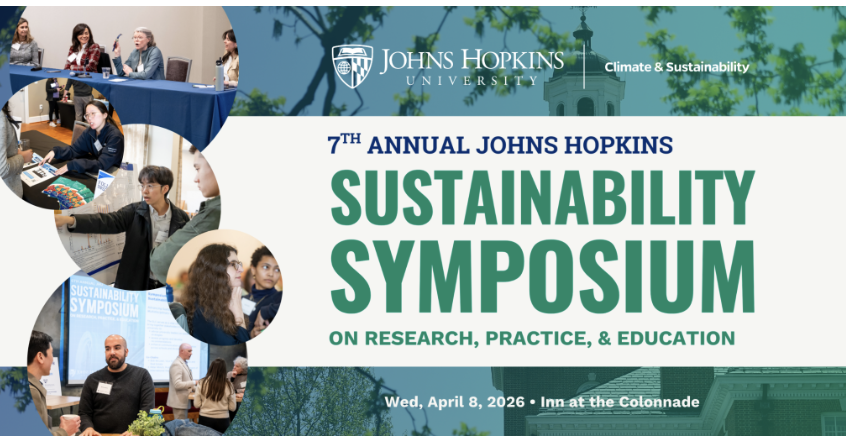
EDC Panel “Antidotes to Toxicity” at 2026 JHU Sustainability Symposium

EDC curators presented their work at the 7th Annual Johns Hopkins Sustainability Symposium
Panel abstract:
Across ecological, social, and institutional domains, “toxicity” has become a defining condition of contemporary life—manifesting as polluted air, soil and water, degraded landscapes, social alienation, and systemic inequities. The proposed panel brings together community-based practitioners working across environmental stewardship, healing arts, design, and the humanities to examine how locally grounded practices function as antidotes addressing both environmental and social toxicities. Panelists will share how their work addresses toxic conditions not only as physical contaminants, but as outcomes of extractive systems, historical exclusion, and imbalanced relationships between people and place. Panelist Samia Kirchner will discuss collaborative approaches for managing land and water rooted in commons-based traditions to enhance community resilience. Alyssa Dennis explores plant medicine, land stewardship, and creative practice as pathways toward embodied healing and relational living in a time of environmental dissociation and resource extraction. Inna Alesina will present invasive plant removal as an act of care and regeneration, restoring forest ecosystems and fostering reciprocal relationships with local landscapes. Siyu Xie will reflect on literary and philosophical traditions that document and interpret the natural world, illuminating how narrative and meaning-making shape our responses to ecological harm. Moderated by anthropologist and Ecological Design Collective curator, Nicole Labruto, this panel invites dialogue on how antidotes to toxicity operate across scales—from the embodied and local to planetary—and how redesigning structures and practices that produce harm can advance environmental justice and multispecies thriving. Together, the panel highlights community knowledge, interdisciplinary collaboration, and care-centered design as essential strategies for cultivating more livable futures.
Moderator: Nicole Labruto is a member of the Curatorial Circle of the Ecological Design Collective, Associate Teaching Professor and Director of the Medicine, Science, and the Humanities Program at JHU, and is the co-chair of the SLC Environmental Justice and Community Partnerships Committee. Working with bioscientists in Brazil, her work integrates the anthropology of science, environmental anthropology, and postcolonial studies to explore the intersection of life forms, landscapes, and labor in relation to postcolonial biologies. Nicole is involved in organizing and activism with a number of environmental justice organizations in Baltimore.
Speakers:
- Dr. Samia Rab Kirchner makes, studies, and analyzes architecture that contributes to urban civic identity, with a focus on the transformative role of water in the design and redevelopment of port cities. She currently teaches Urban Design at Morgan State University in Baltimore. As Community Engagement Lead on the Department of Energy grant-funded Baltimore Social-Environmental Collaborative (BSEC) and on the Maryland Sea Grant-funded Morgan BLUE-CORE projects, she is codeveloping new approaches for climate and coastal scientists to learn from residents of East, West, and South Baltimore, and collaboratively identify community priorities that guide research questions embedded in the community’s lived experiences.
- Inna Alesina is an earth-advocate, and also, a professor of Art and Graphic Design at Stevenson University, an author, a designer and a maker. Her work has merited over a dozen patents, numerous design awards, and has been highlighted by exhibitions, residencies, and workshops. 2018 Red Dot Design Award winner, Alesina works in many disciplines including object design, performance wear, ergonomics, communication design, food systems, and bio materials.
- Siyu Xie is a PhD candidate in the Department of Comparative Thought and Literature at Johns Hopkins University. Her research examines how writers in early modern China developed new ways of observing and describing plant bodies beyond traditional symbolic interpretations, drawing on poetry, essays, and encyclopedic books from the sixteenth to eighteenth centuries. She is a graduate fellow at the Ecological Design Collective.
- Alyssa Dennis is a dedicated earth activist, spiritual ecologist, educator, interdisciplinary artist, clinical herbalist, and is the founder of Eclipta Herbal. Her work centers on reclaiming land-based knowledge systems of plant medicine as a path toward ecological & community regeneration, personal vitality, and holistic health. She completed her clinical herbalism training at the Arbor Vitae School of Traditional Herbalism in New York, where she now serves as a clinic mentor, and is the steward of a vibrant herbal sanctuary in Baltimore City—a living classroom and gathering ground for plant medicine education, earth skills workshops, creative collaboration and community healing.





Responses